
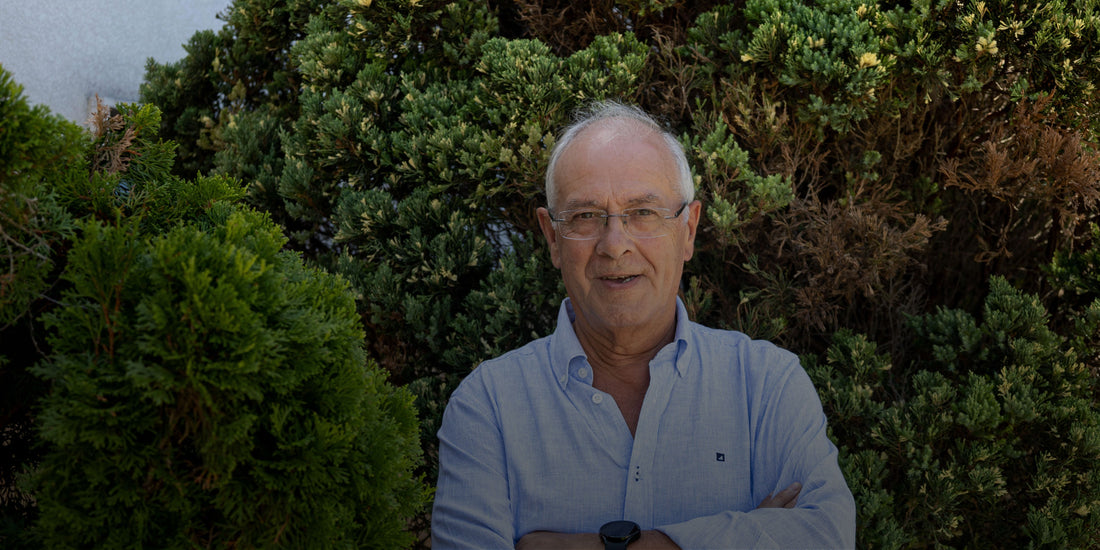
Who is Paulo Gravato as a social leader?
Paulo Gravato is from Vagos, is 72 years old, and studied up to the Instituto Comercial. However, as it was difficult to find a job at the time, he entered a competitive selection process for two banks and joined Fonsecas & Burnay, in Sever do Vouga.
“I worked in several places, but I always lived in Vagos, and I’ve been here at the Misericórdia since 1982. I have been a volunteer since that year: I served as treasurer for three years and then became the provider, a role I have held until today. I will finish this final term in 2026,” he states.
And what are you most proud of in such a long career?
To spend 42 years in an institution like this, you really have to enjoy volunteering, because I would finish work late at the bank and only then would I come to the Misericórdia. But it is a pleasure and a huge source of pride to belong to such an institution.

Nothing pays us for this, but being dedicated to society is something innate, and that is what I know how to do. Of course, there are some downsides: the family suffers because it’s many hours away. For instance, in August I had several meetings, as I am responsible for two districts, Aveiro and Coimbra, and since I am part of the National Secretariat of the Union of Misericórdias, I handle that oversight.
You mentioned that it is a source of pride. And why this pride?
The activity has been so extensive over all these years that new things are always emerging that are exciting. When I came to the Misericórdia, none of this existed: the daycare center was built when I joined, and then there was that work that brings pleasure in managing to raise funds to carry out the project. Furthermore, we began to understand this more social issue, and we started creating a day center.

What touches us most is seeing people who have no one, have nowhere to sleep, and us being unable at the time to resolve the situation. There was a case of two people who came to the day center but had nowhere to sleep. I managed to get one of the day center staff members to accompany the people who, at first, stayed here, but later would go to sleep at her house. There you have it: if it weren't for that solidarity on the part of the staff member, it would have been much harder to resolve the situation. Social situations, for those who feel them, are quite touching.
On one hand, there is something that motivates you, which is not being insensitive to the problems of society and people. On the other hand, being here for 40 years is about a sense of fulfillment and having people here who are dedicated to greater causes.
Correct, and managing to ensure that the management is good.

What is good management in the Social Economy?
First of all, the technical staff must be capable of resolving all situations within the institution; it cannot be just the administrative board. We are volunteers and provide the guidelines, but the management must also be carried out with them.
Behind management comes sustainability, and this is fundamental in the institution, both in terms of services and other departments or activities that generate income, such as our Physical Therapy unit.
Many non-profit organizations (IPSS) are born to solve a problem, but many institutions stop there… In this case, by having someone who leads for 40 years and who has the vision or ambition to respond, having medical care, care for the elderly, continuing care… There are non-profit organizations that were born with a purpose and never went beyond that.

Correct, but that depends a lot on the administrative board and has to do with our own vision of everything, of the institution from the beginning. We cannot stop in time and continue to think as it was in the past. We have to try to achieve more profitability.
How is it to hire, train, and keep people motivated?
We worry, as I told you, mainly about technical personnel. For example, we have two nurses and only one is required. We have a doctor that no one requires, who comes here every day and whom we pay for that, as it prevents most of the users from going to the hospital, and that alone is a huge asset.
For instance, we make use of internships, but most of the interns stay here. The employees here have 24 days of vacation per year, we provide attendance bonuses, we organize activities...
At Mistolin Profissional and Mistolin Solutions, when talking about products, people expect them to be quality products that solve problems… That is our basic premise. We seek to be different and to be part of our customers' lives and, therefore, we created a Mistolabs project, which aims to empower professionals. How can we help empower the social sector?

In terms of training, that is very difficult because training must be provided in the workplace. There are two training issues there: convincing people that it must be done that way and, on the other hand, the application of the products. I know that you provide training, bring the products, and explain how they are applied.
One of the aspects that is critical for us is: how to purchase, how to manage, how to create procedures. Because when we provide training, it is on-site; now, helping to cooperate, to choose, to create procedures… this has implications for productivity.
There is one thing you have to keep in mind: one of everyone's concerns is price. And that is where your training for any equipment comes in: price sometimes does not tell the whole story, and we know that perfectly well here. If I can use less product and have the same quality, I am making money, even if the price is higher.
When the word Mistolin appears, what comes to mind?
First, quality comes to mind; the products really do have quality. And then I think

that you have a sensitivity toward the Social Economy. At least with us, that has been the case. And for institutions, that is an important added value.
There is something that hasn't reached companies yet, which has to do with social enterprises. It already exists in Europe and has to do mainly with taxation—what companies can obtain if they want to be social enterprises.
Beyond the suggestion for Mistolin to become a social enterprise, what other suggestion might you have for the Mistolin group?
I have several. If you want to be supportive, you can find ways to contribute however possible to show the social sector, in some way, "we are here, we are, and we want to be supportive." On the other hand, there is volunteering.

