
The added value of the pre-impregnation system in a hospital setting
Discover the history of the Hospital da Ordem Terceira Chiado
On August 4, 1671, the first stone of what would become the Hospital da Ordem Terceira was laid by Friar Domingos da Cruz, its founder.Having started operations in 1672 and been inaugurated on August 4, 1673, this hospital, which began as three wards, was hit by a fire in 1741 and the earthquake of 1755. The reconstruction works of the hospital were only completed in 1779, as deduced from the Latin inscription above the hospital's main door. In its secular building, in the heart of the city, the institution has maintained its essential values since its foundation. Its history, unique in Portugal, makes this hospital unit an exemplary case in the healthcare sector.
The HOTC provides a professional hospital service, with a clinical staff of excellence in various clinical and surgical specialties.
The hospital belongs to the Fraternity of the Venerable Third Order of St. Francis of the City, now called the Fraternity of St. Francis of the City, OFS (Secular Franciscan Order), founded on July 12, 1615 (17th Century).
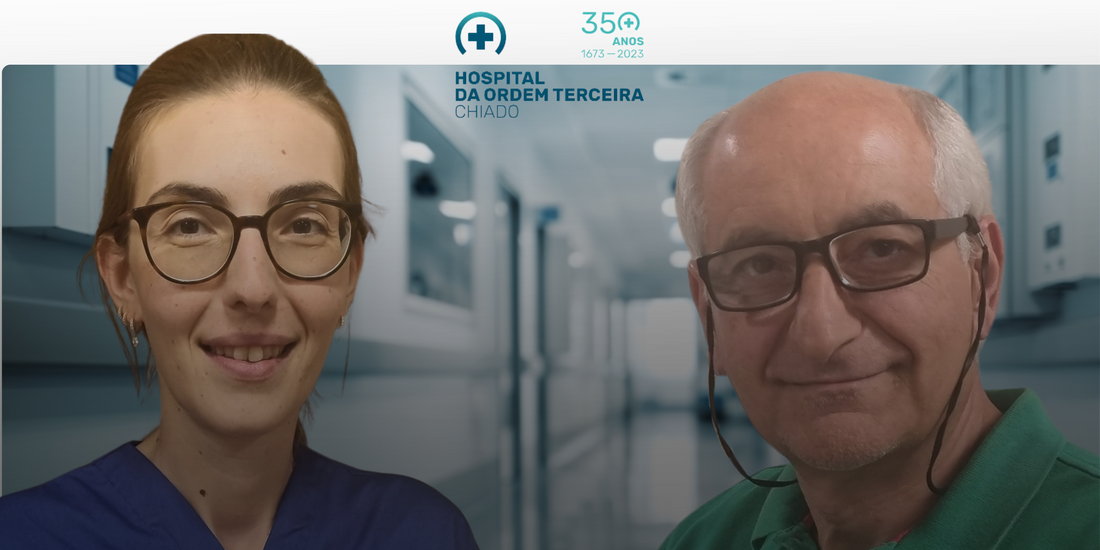
Who are Cátia Bulhão and Manuel João and what is their role at the Hospital da Ordem Terceira do Chiado?
According to Manuel João, he began his tenure at the HOTC in 1994, and in this 29-year journey, he has held various positions within the organization. Currently, he is responsible for the Maintenance, Procurement, and Support Services departments. As for Cátia Bulhão she has been the Head Nurse of the Operating Room and Central Sterilization Department since 2019. Within the HOTC, her role involves managing the nursing team, operational assistants, and the secretariat attached to these departments, ensuring that the practices performed are in accordance with the most up-to-date standards/guidelines and evidence for the sector.

How do you perceive the importance of hygiene and cleaning in the hospital sector?
Manuel João states that cleaning and disinfection in the hospital sector is fundamental for the safety of patients and employees, while Nurse Cátia Bulhão adds that hygiene and cleaning in the hospital sector play a pivotal role. In the context of the operating room, it is the foundation for providing excellent care.

What is your perspective on the specific challenges and demands you face when ensuring proper hygiene and cleaning in the hospital?
For Manuel João, he believes that “it often has to do with inadequate cleaning processes with deep-rooted habits that we need to correct.” He also adds that “at a time of high staff turnover, where employees transition from other hospital units and bring approaches that are not appropriate, we must provide knowledge and offer new work methods.”
From Nurse Cátia Bulhão’s perspective, “the challenges we face in the operating room are: ensuring all professionals adhere to hygiene procedures as established and respect the turn-around time (rotation between patients).”
Nurse Cátia Bulhão, for you, what was the recent change from the conventional floor cleaning system to the mop pre-impregnation system like for the operational assistants at the Ordem Terceira hospital?
The change was fast and extremely easy, given that the system we had previously was more obsolete, laborious, and above all, tiring for the operational assistant.

What are the main benefits that this change has brought to the hospital, and especially to the team’s day-to-day work?
The cleaning trolley, with a pre-impregnated mop system, allowed for the cleaning of the clean circuit in the context of the operating room to be carried out in accordance with the best recommendations for good practices. It is an ergonomic solution that improves satisfaction, reducing the risk of injury compared to the methodology used previously. It also ensures that the concentration of detergent is always the same, not varying depending on who prepares it.
For the hospital, above all, is the safety of the method, combined with the performance and fluidity of the process; for the team, it is an added value in terms of the effort expended.

For you, what is your opinion on the proper training for the successful implementation of new hygiene and cleaning practices, technologies, and processes?
Training is an integral part of the hygiene and cleaning process and requires continuous updating in order to keep up with the good practices of each department.
Training should be clear and concise, using written work instructions and direct supervision until employees feel confident and comfortable with the process(es). For us, Mistolin Solutions has been a good ally because it allows us to be in constant contact with the best professional hygiene and cleaning practices and procedures.
In this process, what has the experience of working with Mistolin Solutions been like, and how has Mistolin Solutions helped the hospital achieve its hygiene and cleaning objectives?
Mistolin Solutions has been a fundamental partner in the dissemination, training, and introduction of new practices, with state-of-the-art detergents and disinfectants, which ensures that our hygiene and cleaning process runs worry-free. They have also provided significant support for the implementation and consolidation of the process, by monitoring us both in person and remotely.
Please share some examples of situations where Mistolin Solutions has demonstrated exceptional commitment and support.
Manuel João shares that the transition that was made in the hospital laundry allowed them to lower costs and guaranteed excellent results.
As for Nurse Cátia Bulhão, the demonstration of the trolley was carried out by a representative from TTS who came directly from Italy.


